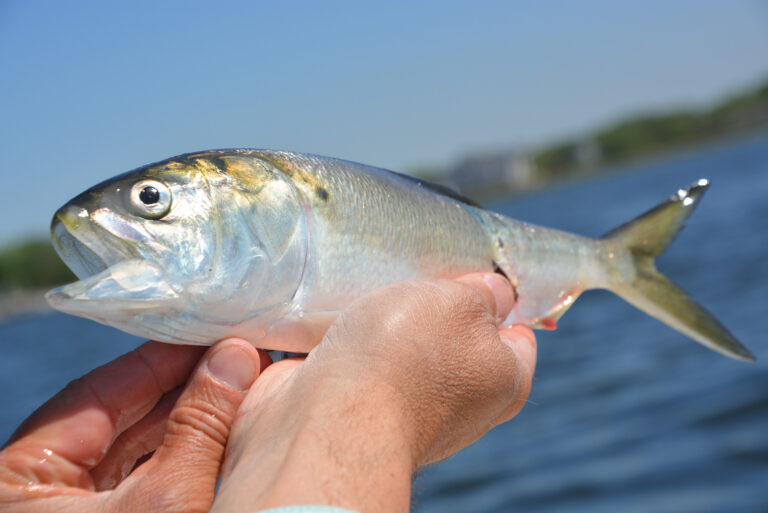
Menhaden are critically important forage fish.
Forage Fish – The Fuel for the Engine
If habitat is the engine that drives our fisheries, forage fish are the fuel that makes system work. We are already losing habitat, so our engine isn’t working on all cylinders. This makes having enough fuel for the system even more important and a top conservation issue.
Forage fish are essential because they transfer energy from the base of the food chain into a form our favorite gamefish can use. Phytoplankton (plant plankton) harness the energy from the sun and nutrients from the water to grow and reproduce. These phytoplankton feed zooplankton (animal plankton). Many forage fish, like menhaden, sardines, herring, feed on plankton. Other forage fish, like pinfish, feed on algae that, although it grows on the bottom, also harvests energy from the sun and nutrients in the water.
However, our gamefish aren’t the only ones who consume forage fish. There are commercial fisheries that target forage fish as well. Unfortunately, many forage fish species either aren’t managed at all or aren’t managed well. This is the case for menhaden. While management on the Atlantic coast has improved in recent years through coordinated management, in the Gulf of Mexico there are no commercial harvest limits, which can result in not enough menhaden for tarpon and other fish that depend on these fish to survive.
Worldwide, harvest of forage fish accounts for around 30 percent of marine fish harvest. Most of the harvest is used as feed for aquaculture, poultry, and livestock, and human nutritional supplements. Some is also used as bait in commercial (crab and lobster traps) and recreational fisheries. Unfortunately, for many fisheries the harvest data are incomplete, so we really don’t know the full impact. What is common among all of these fisheries is that forage fish are being removed from the ecosystem, meaning our gamefish have less to eat.
And most forage fish species haven’t been well-studied, so we don’t have enough basic information for effective management. Despite this lack of information, the precautionary approach to management (which is essentially – first do no harm, be conservative in regulations until more information is available) remains weak or nonexistent.
When we think about what tarpon eat, we’re typically trying to figure out the best fly or lure to use. But from a conservation perspective, we need to focus on protecting the tarpon’s food source. What needs to be done?
- On regulated fisheries, like for menhaden, regulations on forage fish harvest need to account for the gamefish and many species of fish, birds, and mammals that depend on forage fish.
- Forage fish harvest needs to be regulated.
- Studies need to be done to better understand forage fish, and their importance as prey, so that appropriate regulations can be put in place.
- More effort needs to go toward water quality improvements. Harmful algal blooms, which are fed by too many nutrients, kill a lot of forage fish, which means our gamefish have less to eat.
Approximately 90% of commercial menhaden harvest in the Gulf of Mexico occurs off the coast of Louisiana. In addition, unlike the Atlantic States Marine Fisheries Commission, the Gulf States Marine Fisheries Commission has no regulatory authority, making regional menhaden management challenging. Because of this, BTT is working with our conservation partners to establish meaningful regulations for menhaden management in the state of Louisiana. BTT’s initial goal is to establish a ½ mile minimum buffer from shore for commercial menhaden activities and a cap on the amount of menhaden that can be harvested to protect vibrant inshore habitat and prevent additional harvest. In the long term, additional scientific studies will inform an ecosystem-based management approach that accounts for the important role of menhaden in the food chain to ensure an abundant prey-base for one of our nation’s most iconic fishing destinations.
As a member of the Center for Sportfishing Policy, BTT also supports new federal legislation to address forage fish management.
In 2024, BTT advocated for new fishing regulations for the Louisiana Menhaden Commercial Fishing Industry. Learn more.