
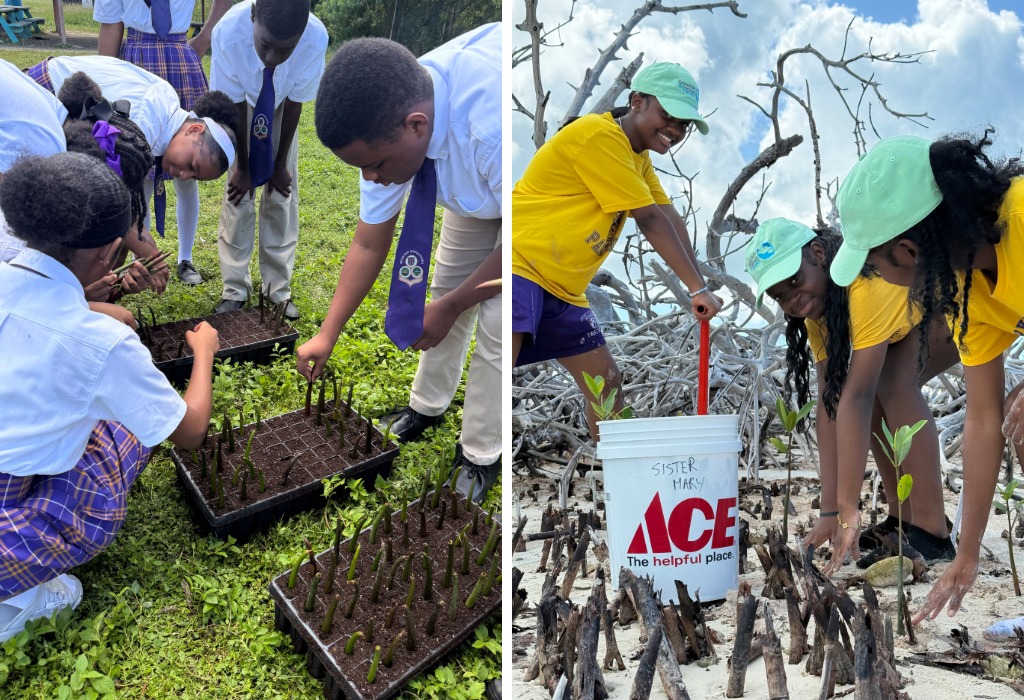
What started as a classroom lesson early in the 2025 school year for students at Sister Mary Patrica Russell Junior High School in Freeport, Grand Bahama, became an incredible journey in mangrove restoration.

Students left their desks and waded knee-deep in mud as they joined the Bonefish & Tarpon Trust (BTT) team to plant mangrove seedlings, which they’d spent months growing, to restore key bonefish habitat damaged by Hurricane Dorian. These Grade 8 students began their mangrove habitat restoration journey by collecting red mangrove propagules and bringing them back to campus, where they watered and grew them into seedlings that would restore vital bonefish habitat, connecting education, conservation, and hands-on stewardship.
BTT’s Bahamas Outreach and Education Coordinator Nina Sanchez visited the school to speak about the importance of mangroves in The Bahamas and their role in bonefish and the Bahamas’ incredible flats fishery. Nina explained that mangroves serve as key habitats for bonefish and as nurseries for other marine species, supporting both the flats fishery and other commercially important fisheries that play an important environmental and socio-economic role in The Bahamas. She highlighted another essential role mangroves play: protecting coastlines from storm surge and erosion, while also positively impacting water quality and strengthening resilience to climate change.
For many students, it was their first time learning about the roles of mangroves for both marine organisms and society. And many of them had never explored these spaces before. This mangrove initiative allowed the message to go beyond the classroom walls.
Rather than just learning about the value of these ecosystems and the importance of conserving and protecting them, the students were able to become directly involved in restoration activities. The pictures in the slideshow they saw earlier in the year would soon become a reality.

After the presentation, it was time for a series of unique field trips. The journey began with collecting mangrove seeds (propagules) from healthy mangrove areas, while also learning how mangroves naturally reproduce and spread across wetlands, flats, and shorelines.
Back at school, it was time to plant those seeds and watch them grow.
Students built troughs and monitored the propagules over the following months, designing simple science experiments that paired with skills they were learning in their regular science lessons.
“The benefits of engaging students in these habitat restoration practices go far beyond the activities themselves,” said Nina Sanchez. “When you look at the individual components of this program, from building troughs to growing seedlings, we are exposing our youth to real-life skills and connecting them with flats stewardship and sustainable fisheries and tourism in The Bahamas. The look in a child’s eyes when you tell them that they can mix dirt in their school uniform during the school day is inspiring, and when you turn propagule collection into a competition, you make learning fun and memorable.

Sanchez also noted that “As environmental educators, we must capitalize on this excitement by providing hands-on experiences that expose them to a wide range of activities that are going to allow them to be environmental stewards and contribute to the betterment of our country.”
For Grade 8 teacher Mrs. Leona Andrews, the project provided an opportunity to bring science lessons to life.
“Harvesting and cultivating mangrove propagules with the students of Sister Mary Patricia Russell Junior High School has transformed abstract textbook science into hands-on learning,” she said. “It deepens environmental stewardship by showing students firsthand how their actions protect our coastlines and instils a sense of long-term responsibility regarding vital ecosystems. I am sure my students are thankful to BTT and the Ministry of Tourism GBI for initiating this project and allowing them to get real-world, STEM learning and be a part of this program.”

The students themselves embraced every stage of the journey.
Victory Grant, a Grade 8 student, recalled the excitement of watching the project unfold.
“We took our first field trip to a mangrove habitat last semester. I was so excited because I had never seen a mangrove before,” Grant said. Searching for the little propagules was very fun. Then we took the propagules back to our school, where we planted them in our garden and continued to learn about how they grow and why mangroves are so important to protect our islands. It was a long process of taking care of the propagules and making sure they had enough moisture to stay alive. Watching them grow from little seeds to baby plants was tiring but fun because I got to do it with my classmates. By the end, hundreds of baby red mangroves were planted. It was an experience I’ll never forget.”
That process culminated on Earth Day in April of this year when the students joined BTT’s East End Restoration Crew and other schools to plant the mangroves at a restoration site in East Grand Bahama.
Trekking through mud and shallow water, they saw firsthand what it takes to restore the mangrove forests that support marine life and protect shorelines, and they had fun while doing it.
Jermaine Johnson, with the Ministry of Tourism, Grand Bahama Island’s Sustainable Development Department, which partnered with BTT on the initiative, said the project demonstrates the value of collaborative conservation and youth engagement.
“The success of this initiative highlights how collaboration between the Ministry of Tourism, GBI and BTT can create a lasting impact,” Johnson said. “When students actively participate in restoration, from trough building, to seed collection, to nurturing propagules and then outplanting, they gain a sense of ownership and responsibility that will influence how they care for our environment long into the future.”

The initiative reflects BTT’s broader commitment to youth engagement and environmental education throughout The Bahamas, helping young people understand that scientists aren’t the only ones involved in conservation and that they, along with their communities, play an important role.
Helping students understand the connection between mangrove restoration and bonefish habitat was particularly important. Healthy mangrove-based ecosystems provide shelter and feeding grounds for bonefish, their prey, and other species that support a thriving recreational fisheries sector across The Bahamas.
By restoring mangroves today, students are helping protect the future of Bahamian fisheries for generations to come, and exposing students to these activities during the school year can foster environmental stewardship.
From learning in the classroom to getting their hands in the mud, students at Sister Mary Patricia Russell Junior High School helped restore red mangrove habitats on a national scale and inspired a new generation of Bahamian environmental stewards.